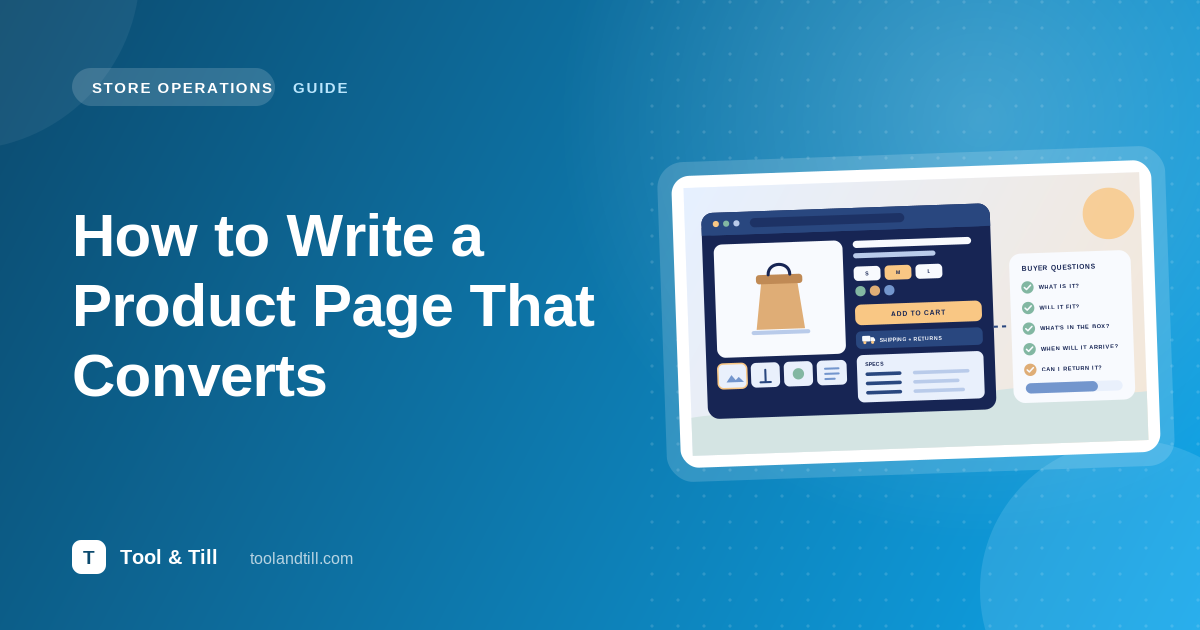
A product page has one job: answer the questions a shopper has before they are willing to add something to the cart. When a page leaves out what is in the box, whether it fits, when it arrives or how returns work, the shopper either leaves to look it up elsewhere or contacts you. Neither helps the sale.
This guide breaks a product page into the parts buyers actually check, in roughly the order they check them, and shows where platform and search documentation from Shopify, Google and the US Federal Trade Commission (FTC) sets requirements you should follow. It is not a list of conversion "hacks", and it does not promise any specific lift in sales.
Start with facts, not copy
Before you write a sentence, collect the verified facts for the product: model, variants, materials, dimensions, compatibility, what is included, care instructions and warranty. Our guide to building a product fact sheet before writing gives a template. Every section below draws on that sheet, which keeps the page consistent with your feed, your packaging and your support answers.
Persuasive copy cannot fix a missing fact. If a shopper cannot find the size, the material or the return window, a better adjective will not help.
The parts of a product page, in the order buyers read them
1. A clear, specific title
The title should say what the product is in plain words, plus the attribute that separates it from its siblings. Google's Merchant Center guidance for titles suggests a pattern such as brand, product type and then important attributes like color, size, material or pattern for apparel, and says Google may move key attributes to the front of a title to match a search. Your on-page title does not need to copy your feed title, but keeping them close makes the listing and the page feel like the same product. Google also says feed titles should match the landing page.
2. Images that show what the shopper will receive
Use the first image to show the product clearly, then add angles, close-ups, scale and in-use shots. Google's Merchant Center image guidance warns against watermarks, promotional overlays and anything that distracts from the product in the main image, and Google has announced that product images must be at least 500 x 500 pixels from January 31, 2027. Even if you never use Google Shopping, those rules describe a clean, honest main image.
Add alt text to every image. Shopify's help center describes alt text as a description of the media that is read by screen readers and shown if the image fails to load. Describe what is in the picture, for example "Ceramic mug in sage green, shown next to a paperback for size", not a list of keywords.
For lighting and backgrounds, see our product photography lighting guide.
3. Variant choices that cannot be misread
Size, color and pack-count selectors should change the image, the stock status and any variant-specific details. If a variant has its own facts, such as a different capacity or material, say so near the selector. Shopify's theme documentation covers how themes display variant media; check your theme shows the right image when a shopper switches variant.
4. A short summary above the fold
Two or three sentences next to the buy button: who the product is for, the main problem it solves and the one fact most people ask about. Save the full story for further down the page.
5. Details and specifications
Put measurable facts in a scannable list or table: dimensions, weight, materials, compatibility, capacity, care and what is in the box. Separate "included" from "sold separately". This section is where most returns are prevented, because it is where a shopper confirms fit.
6. Shipping, returns and policies near the decision
Shoppers look for delivery and return terms before they buy, not after. Shopify's help center explains that policies added under Settings > Policies are linked automatically in the checkout footer, and recommends linking them in your store navigation as well. On the product page itself, add a one-line summary of the return window and a link to the full policy.
7. Reviews and social proof you can stand behind
Only show reviews from real customers. The FTC's rule on consumer reviews and testimonials, in effect since October 21, 2024, prohibits fake or false reviews (including AI-generated reviews attributed to people who do not exist), buying positive or negative reviews, undisclosed insider reviews and review suppression. If you sell outside the US, check your local consumer protection rules too.
8. Answers to the questions people actually ask
Read your support inbox, chat logs and returns reasons. Turn the most common questions into a short FAQ block on the page. If you use an AI assistant for support, the same answers feed it; see our AI chatbot setup checklist.
Help search engines read the page
Google's merchant listing documentation explains that Product structured data, with an Offer that includes price, currency and availability, can make a product page eligible for merchant listing experiences in Search. Google's return policy and shipping documentation also describes markup for return windows and shipping details, and notes that if you already provide those policies in Merchant Center you do not need to repeat them in markup. Shopify's theme documentation describes a Liquid structured_data filter that outputs schema.org Product markup (or ProductGroup for products with variants); check what your theme already outputs with a validator rather than adding a second copy. Our Google Merchant Center free listings guide covers the feed side.
Using AI to draft product copy
AI tools can turn a fact sheet into readable copy quickly, but they can also add features that are not real. Give the tool your fact sheet, ask it to use only those facts, and check every factual sentence before publishing. Our guide to Shopify Magic for product descriptions walks through that review.
Product page checklist
- Title says what the product is plus its key attribute
- First image is clear, with no watermark or promotional overlay
- Extra images show scale, detail and the product in use
- Every image has descriptive alt text
- Variant selector updates image, stock and variant-specific facts
- Two-to-three sentence summary sits next to the buy button
- Specifications list covers dimensions, materials, compatibility and care
- "In the box" and "sold separately" are listed separately
- Shipping and return summary with a link to the full policy
- Reviews are from real customers only, with no suppression
- FAQ answers the top questions from support and returns
- Structured data is present once and validates
- Page has been checked on a phone, not just a desktop
FAQ
How long should a product description be?
Long enough to answer the buying questions, and no longer. A simple product may need a short summary plus a specification list; a technical or expensive product needs more detail on compatibility and use. Keep paragraphs short and put measurable facts in a list.
Should my product page title match my Google Shopping title?
They do not need to be identical, but Google's Merchant Center guidance says the feed title should match the landing page. Keeping the product type and key attributes consistent avoids confusing shoppers who click through.
Can I write or edit customer reviews?
In the US, the FTC rule prohibits fake reviews, reviews that misrepresent the reviewer, and suppressing negative reviews. You can moderate for genuinely irrelevant or abusive content under a consistent policy, but do not invent, rewrite or selectively hide reviews.
Do I need structured data if I use Shopify?
Many Shopify themes already output product structured data, using the Liquid structured_data filter Shopify documents for themes. Check your page with a validator first; adding a second set from an app can create duplicate or conflicting markup.
About this guide
This guide is based on publicly available documentation from Google, Shopify and the FTC, listed in the sources below. It is an editorial checklist, not a hands-on test or a conversion-rate study, and it is not legal advice. Requirements change, so confirm current rules in each source before relying on them.