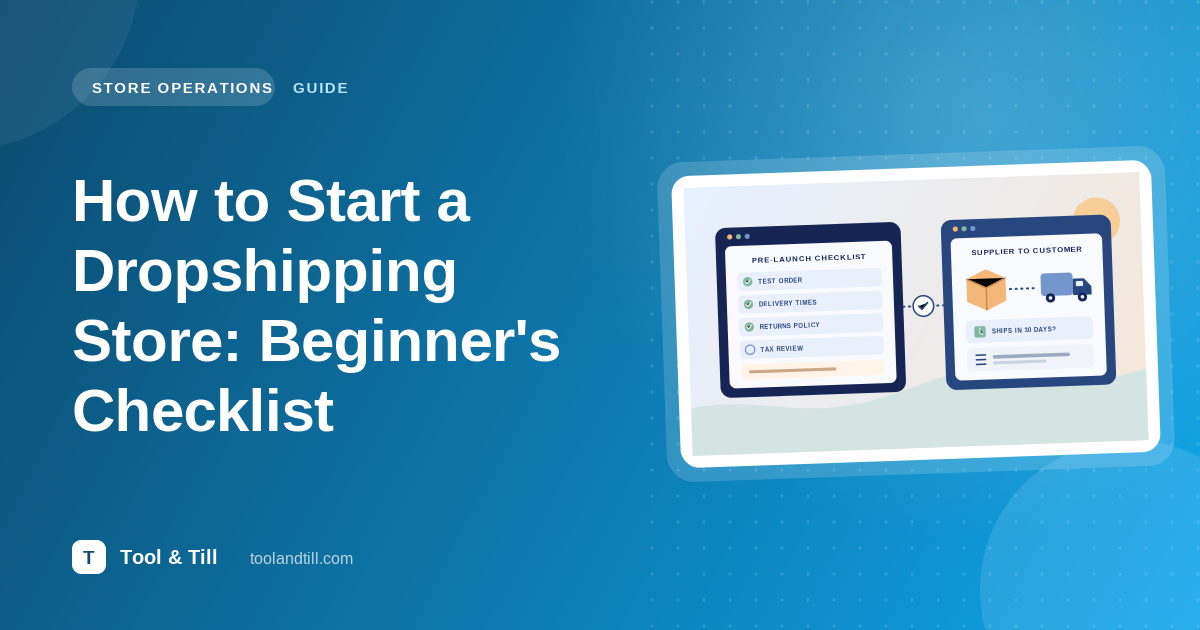
Dropshipping lets you sell products without holding stock: a supplier picks, packs, and ships each order to your customer. That removes warehousing from your to-do list, but it does not remove responsibility. In the US, the UK, and most other markets, the store that takes the order is the seller the customer — and the regulator — deals with.
This checklist walks through what to settle before you launch, based on Shopify's dropshipping documentation and official consumer-law guidance for the US and UK.
Understand what you are still responsible for
Shopify's Help Center describes dropshipping as a model where the supplier handles picking, packing, and shipping while you remain responsible for customer service and order tracking. Its compliance guidance goes further: dropshippers need to follow the rules that apply to retailers of the products they sell, and those rules depend on where the store is based and where it sells.
A supplier ships the parcel, but the promises on your product page, checkout, and policies are yours.
That framing should shape every step below.
Step 1: Choose a platform you can actually run
Decide who will maintain the store day to day. A hosted platform handles software, hosting, and checkout infrastructure for you; a self-hosted setup gives more control but more upkeep. Our Shopify vs WooCommerce comparison covers that trade-off from vendor documentation.
If you use Shopify, its Help Center lists several sourcing routes: Shopify Collective (for connecting with other Shopify suppliers, with eligibility rules), dropshipping apps from the Shopify App Store, and print-on-demand apps. Check each app's own documentation for which markets and suppliers it supports.
Step 2: Vet suppliers before you list anything
Shopify's guide to choosing suppliers recommends a few practical checks:
- Place test orders. Ordering from a supplier before you commit shows how they handle orders, how long processing and delivery take, and how quickly tracking information arrives.
- Inspect what arrives. Look at packing quality, product condition, and whether the item matches the supplier's description.
- Watch for resellers. Shopify notes that a supplier selling to the public while advertising "wholesale pricing" is likely another dropshipping business rather than a true wholesaler.
- Read policies and talk to them. Review the supplier's return, defect, and communication policies, and contact them directly before signing up.
Write down what you learn. A short product fact sheet keeps specifications, package contents, and compliance details in one place so your product pages do not promise more than the supplier delivers.
Step 3: Check product safety and listing claims
Shopify's dropshipping compliance page warns that sellers may still be liable for unsafe products even when a third party ships them, and recommends vetting suppliers and checking for recalls before listing. For each product, confirm:
- The safety standards or certifications that apply in each country you sell to.
- Whether any category restrictions or platform rules apply.
- That every specification on the page comes from the supplier's documentation, not guesswork.
Step 4: Set honest shipping expectations
Delivery times are where many dropshipping stores run into trouble, and both US and UK rules address them directly.
United States
The FTC's Mail, Internet, or Telephone Order Merchandise Rule requires sellers to have a reasonable basis for any shipping time they advertise. If no time is stated, the seller must have a reasonable basis to ship within 30 days. If an order cannot ship on time, the seller must notify the customer and either get their consent to the delay or refund them. The FTC's business guide states that using a drop shipper does not shift this responsibility away from the seller.
United Kingdom
GOV.UK guidance on online and distance selling says goods must be delivered without undue delay and, unless another timescale was agreed, within 30 days of the contract. If you miss that, the customer can cancel and get a full refund.
What this means for your store
- Base delivery estimates on your test orders, not the supplier's best case.
- Show shipping times and any import or customs charges before checkout, as Shopify's compliance guidance recommends.
- Tell customers when a product ships from a third party or another country.
- Prepare a delay email template so you can notify customers quickly.
Step 5: Write returns and cancellation policies you can honour
UK distance-selling rules give customers a cancellation period of 14 days, and GOV.UK says refunds must be issued within 14 days of receiving the goods back (or evidence they were returned). You must refund standard delivery costs, and you can only make customers pay return postage if you told them before they bought.
Your policy has to work with your supplier's. If the supplier will not accept returns to their warehouse, decide where returned items go and who pays before your first sale.
Step 6: Get the business basics in order
- Business details. UK rules require your identity and contact details before a sale; Shopify notes extra disclosures for EEA sellers, such as company and VAT details.
- Sales tax and VAT. Shopify's guidance explains that US sales tax obligations depend on nexus, and that EU sales from non-EU suppliers can involve VAT and IOSS registration. Talk to a tax professional for your situation.
- Pricing. Your price must cover product cost, shipping, payment fees, and returns; work this out per product before launch.
Beginner's pre-launch checklist
- Platform chosen and someone named to run it.
- At least one test order received from each supplier.
- Supplier processing and delivery times written down.
- Product pages checked against supplier documentation.
- Product safety requirements and recalls checked for each market.
- Shipping times, customs charges, and third-party shipping disclosed before checkout.
- Returns and cancellation policy written and agreed with the supplier.
- Delay notification template ready.
- Business contact details published.
- Tax and VAT obligations reviewed with an adviser.
A note on this guide
This is a documentation-based checklist drawn from Shopify's Help Center and official FTC and GOV.UK guidance, not a hands-on test of any supplier or app. It is not legal or tax advice; rules change, so confirm current requirements with the linked sources and a qualified professional before you launch.